Gilchrist County Dog Registration Information
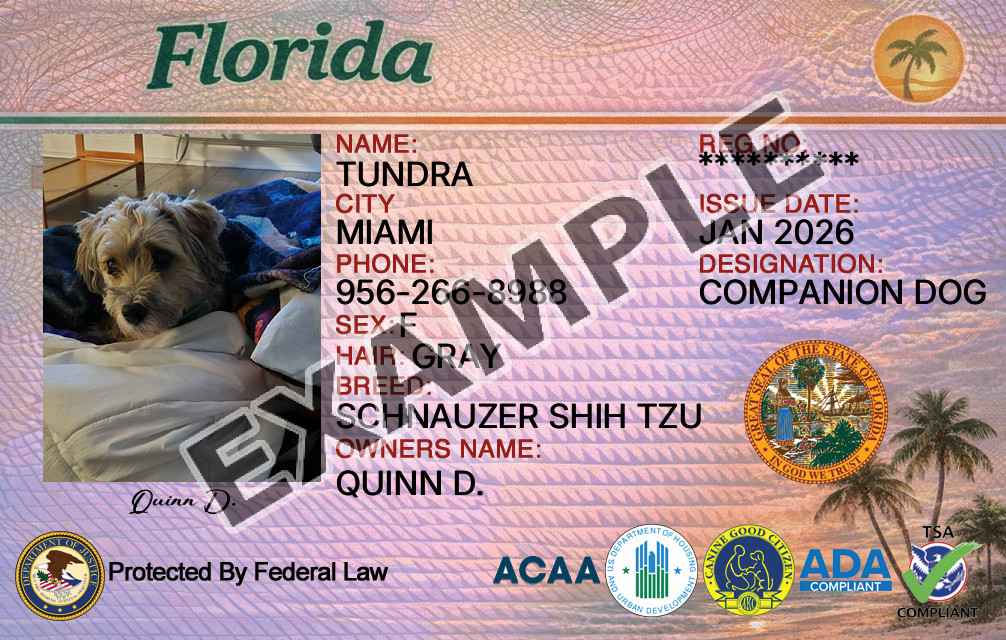
Service Dogs and Emotional Support Animals in Gilchrist, Florida
If you’re searching where do I register my dog in Gilchrist County, Florida for my service dog or emotional support dog, it helps to separate two different topics: (1) county dog licensing / rabies tag requirements (which apply to pets and often apply to service dogs and emotional support animals too), and (2) service dog and emotional support animal (ESA) status (which are legal classifications and accommodations—not a county “registration” in a universal national database).
Where to Register or License Your Dog in Gilchrist County, Florida
The offices below are official agencies serving Gilchrist County residents for animal services and rabies-related public health support. If you are unsure whether your situation requires a county license/tag, start by calling the main animal services office listed here.
Gilchrist County Animal Services (Gilchrist County Animal Shelter)
- Phone: 352-463-4084
- Email: animalcontrol@gilchrist.fl.us
- Hours: Monday – Friday (Appointment Only)
Florida Department of Health in Gilchrist County
- Phone: 352-463-3120
- Email: WebInfoGilchrist@FLhealth.gov
- Hours: Monday–Friday 8:00 a.m. – 5:00 p.m. (Closed Saturday & Sunday)
Overview of Dog Licensing in Gilchrist County, Florida
What “dog registration” usually means locally
In everyday conversation, “registering a dog” often means getting a county license and/or a rabies certificate and tag. In many Florida counties, the county license is closely tied to rabies vaccination status: you provide proof of current rabies vaccination, pay a fee (if applicable), and you receive a tag and/or certificate showing compliance.
Rabies vaccination and a county license/tag can be required
Gilchrist County’s animal-related rules can require that dogs (and often cats) above a certain age are licensed and that the licensing process includes proof of current rabies vaccination. If a veterinarian provides a written medical exemption letter (when vaccination could endanger the animal’s health), the county may allow licensing without vaccination for the period covered by the exemption, subject to renewal requirements.
No universal “service dog registry” for the U.S.
A service dog’s legal status is based on training and disability-related work or tasks (and on the applicable laws for public access or housing), not on a national ID number. Likewise, an emotional support animal is generally supported by documentation from a licensed health care professional for housing-related accommodations, not by a county “ESA registration.”
What You Need Before Registering a Dog
Common documents and information
Requirements can vary by county procedures and by the specifics of your dog (age, vaccination status, altered status, etc.). When contacting animal services about a dog license in Gilchrist County, Florida, plan to have:
- Rabies vaccination certificate from your veterinarian (showing vaccination date and expiration)
- Your contact information (name, address where the dog resides, phone)
- Description of the dog (name, breed, color/markings, sex, age)
- Spay/neuter documentation (if available and relevant to the county’s fee structure)
- Any prior license/tag details (if renewing or replacing a lost tag)
If your dog is a service dog or emotional support animal
Your dog’s service dog status or ESA status typically does not replace local health and safety requirements like rabies vaccination or county licensing. You may still need:
- For service dogs: no universal “registration” is required; be prepared to answer the limited questions allowed in public-access contexts (when applicable) and keep vaccination records current for local compliance.
- For emotional support animals: documentation is primarily relevant to housing accommodations, and it does not automatically create public-access rights like a service dog.
Steps to Register or License a Dog in Gilchrist County, Florida
1) Confirm whether your dog needs a county license/tag
Start by calling Gilchrist County Animal Services and ask what the current process is for an animal control dog license in Gilchrist County, Florida. Because the shelter is listed as appointment only, calling first helps you avoid unnecessary trips.
2) Ensure rabies vaccination is current (or obtain a veterinarian exemption letter)
Many county licensing procedures are tied to rabies vaccination expiration dates. If your dog is due for vaccination, schedule a veterinarian visit. If your veterinarian determines vaccination would endanger your dog’s health, ask for a written exemption letter and then ask animal services how to submit it for licensing purposes.
3) Submit the needed information and obtain your license/tag
Once you have the rabies certificate (or medical exemption documentation if applicable), follow the county’s instructions to obtain the license certificate and tag. Ask about:
- Whether you can complete the process by phone/email or if an in-person appointment is required
- How long it typically takes to receive a tag or replacement tag
- What to do if your dog’s tag is lost or damaged
- How renewals work when rabies vaccination is renewed (for example, one-year vs. three-year vaccination schedules)
4) Keep records and keep the tag attached as directed
After licensing, keep a copy (paper or digital) of your rabies certificate and licensing paperwork in a safe place. Many counties also require the tag to be attached to the dog’s collar and visible. If you travel, having quick access to vaccination records can be helpful if questions come up.
Service Dog Laws in Gilchrist County, Florida
Service dog status is about trained work or tasks, not a registry
A service dog is generally a dog trained to do specific work or tasks for a person with a disability (for example, guiding, alerting, retrieving, interrupting harmful behaviors, or providing mobility support). The key idea is task-trained assistance related to a disability.
Local licensing still commonly applies
Even if your dog is a service dog, you typically still follow local public health and animal control rules—such as rabies vaccination compliance and any applicable county licensing requirements. If you believe an exemption or fee waiver applies to your situation, the most reliable way to confirm is to ask Gilchrist County Animal Services directly.
Emotional Support Animal Rules in Gilchrist County, Florida
ESAs are not the same as service dogs
An emotional support animal (ESA) provides comfort or emotional benefit to its owner, and ESA documentation is most commonly used to request a housing accommodation when allowed by law. ESAs do not automatically have the same public-access rights as service dogs.
ESAs usually still need local rabies compliance and any county licensing
Regardless of ESA status, your dog may still be expected to meet local health and safety requirements, including current rabies vaccination and any applicable dog licensing requirements in Gilchrist County, Florida.
Dog License vs. Service Dog vs. Emotional Support Animal (ESA)
| Category | Dog License (County) | Service Dog | Emotional Support Animal (ESA) |
|---|---|---|---|
| What it is | Local county licensing and identification process, often linked to rabies vaccination and a tag/certificate. | A dog trained to perform disability-related work or tasks for a person with a disability. | An animal that provides emotional support; documentation is typically used for housing accommodations when allowed. |
| Who issues it | County animal services (and/or authorized issuing channels the county recognizes). | No universal issuing agency; status is based on training and legal definitions under applicable laws. | No universal issuing agency; typically supported by documentation from a qualified licensed health care professional for applicable housing requests. |
| Common proof | Rabies certificate, payment/fee if applicable, and license tag/certificate. | In many public-access contexts, you are not required to show an ID card; the dog must be under control and behave appropriately. Vaccination records may still matter for local compliance. | Housing-related documentation (when applicable) plus compliance with local animal health rules (e.g., rabies vaccination and licensing if required). |
| Public access | No special public access rights by itself. | Generally allowed in public places where the handler is permitted, subject to applicable rules and the animal being under control. | Does not generally grant the same public-access rights as a service dog. |
| Does it replace county licensing? | Not applicable. | No. A service dog may still need to meet county licensing/rabies requirements. | No. An ESA may still need to meet county licensing/rabies requirements. |
Frequently Asked Questions
Do I have to license my service dog in Gilchrist County, Florida?
Many local animal health and control requirements (such as rabies vaccination compliance and any related county licensing/tag requirements) can apply regardless of whether a dog is a pet or a service dog. For the most accurate answer for your situation, call Gilchrist County Animal Services and ask how licensing applies to service dogs at your address.
Is there a federal registry for emotional support animals or service dogs?
No. There is not one universal federal government registry where all service dogs or emotional support animals are registered. Local dog licensing is separate from service dog or ESA legal status.
What if my dog is moving to Gilchrist County from another county or state?
If you relocate into Gilchrist County, call Gilchrist County Animal Services to confirm how quickly you need to obtain a local license/tag and what documents they accept as proof of rabies vaccination. Having your veterinarian’s rabies certificate available will usually help speed up the process.
Who do I call about a bite or possible rabies exposure?
For bite/scratch reporting and rabies guidance, contact the Florida Department of Health in Gilchrist County. For locating or confining an animal involved in an incident, Gilchrist County Animal Services may also be involved. If there is an immediate emergency, contact emergency services.
Do cities inside Gilchrist County have different rules?
Some municipalities can have additional ordinances related to animals (for example, leash rules, nuisance rules, or enforcement processes). If you live inside a city limit (such as Trenton or Fanning Springs), ask Gilchrist County Animal Services whether any city-specific steps apply to your address.
Search-friendly local terms (for clarity)
This page addresses common questions like:
- where to register a dog in Gilchrist County, Florida
- dog license in Gilchrist County, Florida
- animal control dog license Gilchrist County, Florida
- dog licensing requirements Gilchrist County, Florida
Register A Dog In Other Florida Counties
Select your county below to get started with your dog’s ID card. Requirements and license designs may vary by county, so choose your location to see the correct options and complete your pup’s registration.
- Alachua Dog License Cards
- Baker Dog License Cards
- Bay Dog License Cards
- Bradford Dog License Cards
- Brevard Dog License Cards
- Broward Dog License Cards
- Calhoun Dog License Cards
- Charlotte Dog License Cards
- Citrus Dog License Cards
- City of Jacksonville Dog License Cards
- Clay Dog License Cards
- Collier Dog License Cards
- Columbia Dog License Cards
- DeSoto Dog License Cards
- Dixie Dog License Cards
- Duval Dog License Cards
- Escambia Dog License Cards
- Flagler Dog License Cards
- Franklin Dog License Cards
- Gadsden Dog License Cards
- Glades Dog License Cards
- Gulf Dog License Cards
- Hamilton Dog License Cards
- Hardee Dog License Cards
- Hendry Dog License Cards
- Hernando Dog License Cards
- Highlands Dog License Cards
- Hillsborough Dog License Cards
- Holmes Dog License Cards
- Indian River Dog License Cards
- Jackson Dog License Cards
- Jefferson Dog License Cards
- Lafayette Dog License Cards
- Lake Dog License Cards
- Lee Dog License Cards
- Leon Dog License Cards
- Levy Dog License Cards
- Liberty Dog License Cards
- Madison Dog License Cards
- Manatee Dog License Cards
- Marion Dog License Cards
- Martin Dog License Cards
- Miami-Dade Dog License Cards
- Monroe Dog License Cards
- Nassau Dog License Cards
- Okaloosa Dog License Cards
- Okeechobee Dog License Cards
- Orange Dog License Cards
- Osecola Dog License Cards
- Palm Beach Dog License Cards
- Pasco Dog License Cards
- Pinellas Dog License Cards
- Polk Dog License Cards
- Putnam Dog License Cards
- Santa Rosa Dog License Cards
- Sarasota Dog License Cards
- Seminole Dog License Cards
- St. Johns Dog License Cards
- St. Lucie Dog License Cards
- Sumter Dog License Cards
- Suwannee Dog License Cards
- Taylor Dog License Cards
- Union Dog License Cards
- Volusia Dog License Cards
- Wakulla Dog License Cards
- Walton Dog License Cards
- Washington Dog License Cards
